
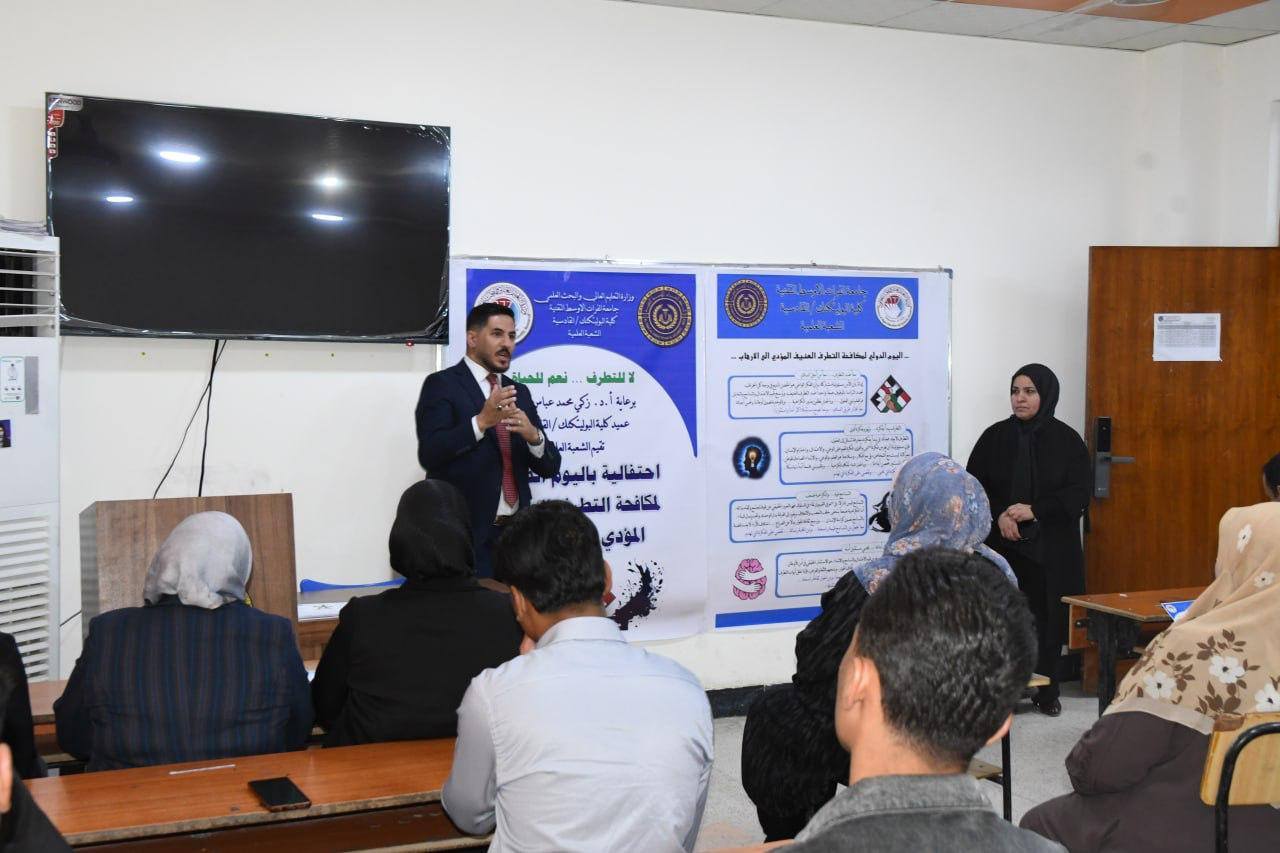
In observance of the International Day for the Prevention of Violent Extremism as and When Conducive to Terrorism, the Scientific Division at Al-Polytechnic College – Al-Qadisiyah, under the patronage of the Dean of the College, Professor Dr. Zaki Mohammed Abbas Bahiyya, and in cooperation with the Women’s Affairs Unit and the Department of Forensic Evidence Technologies, organized an awareness seminar entitled: “Extremism Between the Constitutional Text and Practical Reality in Iraq.” The seminar was delivered by Lecturer Dr. Ali Majeed.
The seminar addressed the issue of extremism in Iraq from two principal perspectives: the constitutional framework that regulates rights and freedoms, and the practical reality marked by political, security, and social challenges. The discussions were grounded in the provisions of the Constitution of the Republic of Iraq, which guarantees freedom of thought, expression, and belief; affirms the principle of political and religious pluralism; and prohibits any entity or approach that adopts racism, terrorism, or takfiri ideology.
The seminar indicated that constitutional texts constitute an advanced foundation for the protection of rights and the prevention of extremism. However, practical implementation faces several obstacles, including limited legal awareness, extremist rhetoric in certain platforms, the political exploitation of sub-identities, and economic and social challenges that may be exploited to recruit youth into extremist ideologies.
The seminar further emphasized that addressing extremism is not confined to the security dimension alone; rather, it requires activating the role of educational, media, and religious institutions, promoting a culture of citizenship and the rule of law, and reinforcing the values of tolerance and dialogue. Participants stressed the importance of aligning legislation with the Constitution and applying it fairly and without discrimination to ensure a stable environment that safeguards society from sliding into violence or terrorism.
The seminar concluded with a recommendation for strengthened cooperation between state institutions and civil society organizations to promote constitutional awareness, support youth initiatives, and build an inclusive national discourse that fosters civil peace and curbs manifestations of extremism within Iraqi society.