
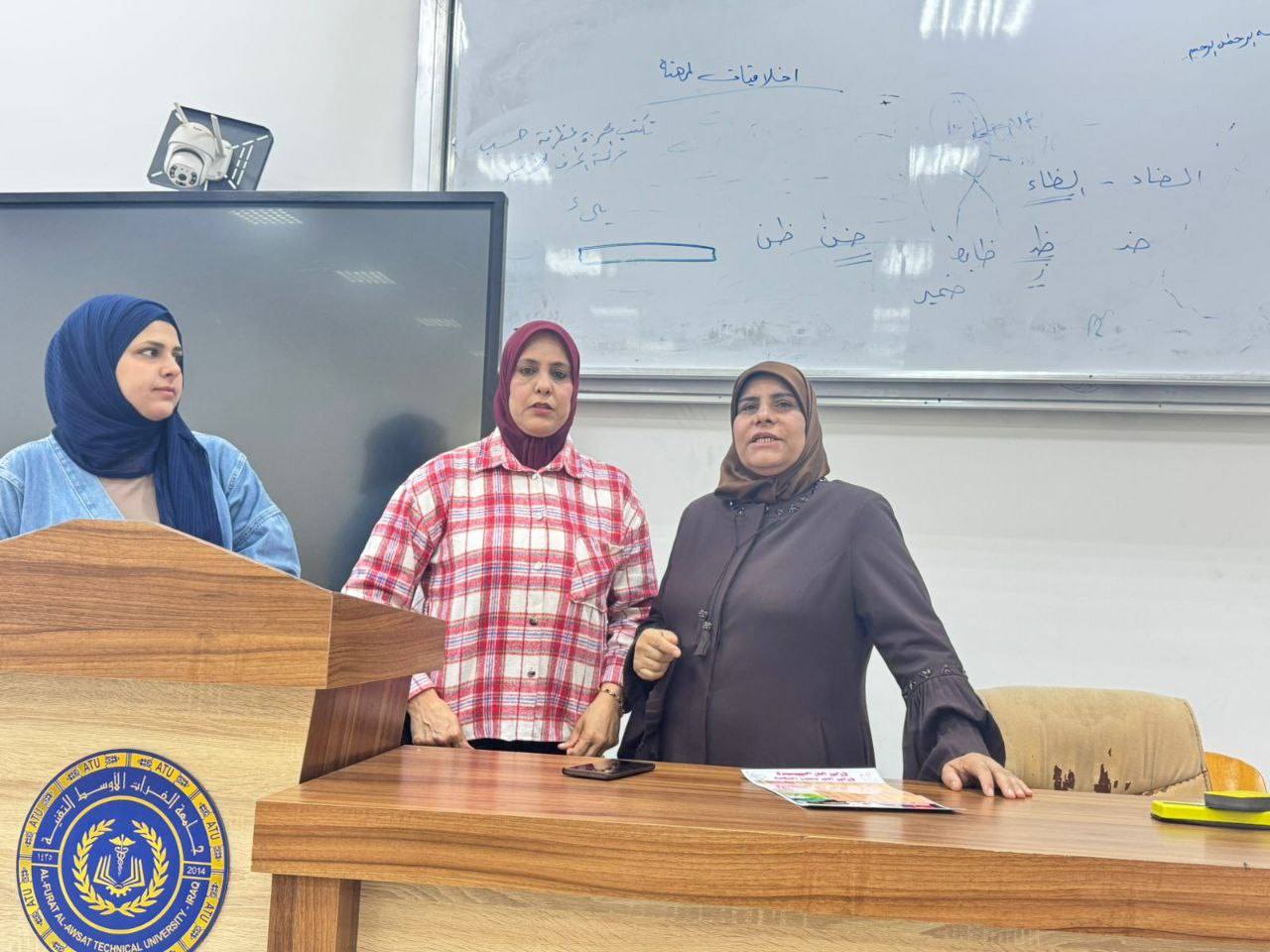
Within the framework of the executive plan of the National Strategy for Women and Peace – Axis Five (Paragraph Four), the Women’s Affairs Unit at the College of Polytechnic – Al-Qadisiyah, in cooperation with the Department of Radiology and Sonar Technologies, held a scientific workshop entitled: (Introduction to the Quality Management System in Accordance with ISO Standards).
The workshop was delivered by Assistant Professor Dr. Afrah Rahim, Assistant Lecturer Suhad Abdul Hussein, and Assistant Lecturer Aseel Abdul Sattar. They addressed several themes focusing on the importance of implementing quality systems in educational and service institutions.
The workshop explained that the Quality Management System in accordance with ISO standards is considered one of the modern administrative systems aimed at improving institutional performance and ensuring the provision of high-quality services or products that meet beneficiaries’ requirements and achieve their satisfaction. This system is based on standards established by the International Organization for Standardization, known by the abbreviation (ISO), the most prominent of which is ISO 9001, which pertains to the Quality Management System.
The workshop further emphasized that the Quality Management System is founded on establishing clear policies and procedures to regulate work, define responsibilities, and continuously monitor performance, while adopting the principle of continual improvement and preventing errors before they occur rather than addressing them after they arise. It also relies on documenting processes, measuring beneficiary satisfaction, analyzing risks, and making decisions based on data.
The themes of the workshop indicated that institutions seek, through the implementation of this system, to enhance performance efficiency, reduce waste, and strengthen trust between themselves and beneficiaries, in addition to improving their competitive reputation. It also affirmed that the application of ISO standards is not limited to the industrial sector alone but extends to educational, service, health, and other institutions, as it provides an organizational framework that contributes to achieving quality and sustainability in work.